
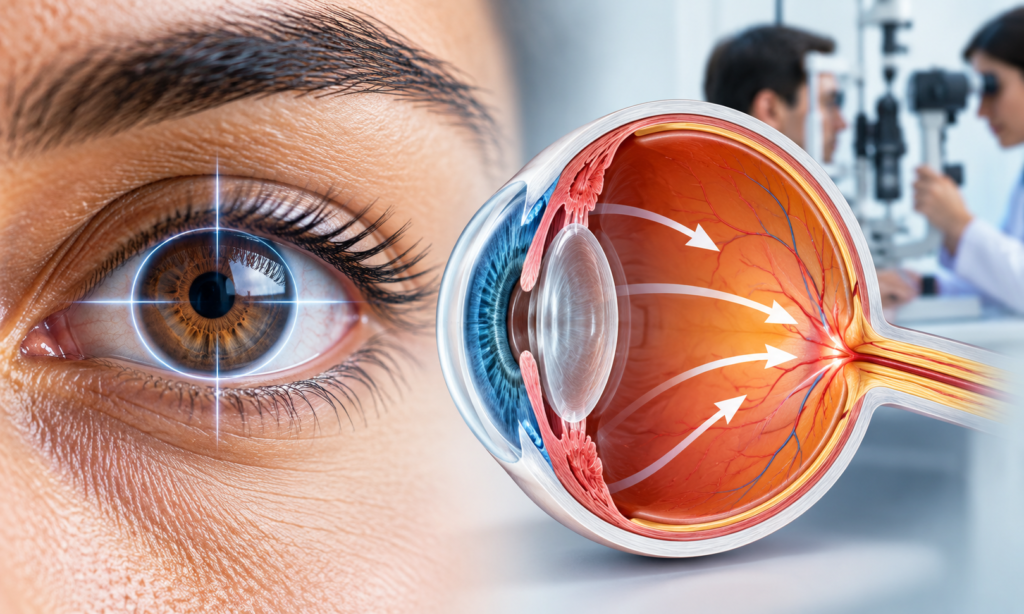
What is Open-Angle Glaucoma?
Open-Angle Glaucoma is an eye disease where the intraocular pressure build-up damages the optic nerve, thereby leading to vision loss and eventual total blindness if undetected and untreated.
Known to be the most common type of glaucoma, Open-Angle Glaucoma is slow and gradual; the worst part is it’s asymptomatic – you have it but don’t know about it. That is why it often goes undetected in the early stages.
What Are the Symptoms of Open-Angle Glaucoma?
Are you lately finding it difficult to read road signs while driving? Do you often happen to miss a step while climbing down a staircase?
If your answers are in the affirmative, then it’s ‘tunnel vision’ at work and you have a strong likelihood of being afflicted by open-angle glaucoma.
Notoriously known as the “silent thief of sight”, open-angle glaucoma, as mentioned earlier, is asymptomatic in its early stages. Moreover, if one eye is affected by glaucoma to a higher degree than the other, the healthier eye compensates and again glaucoma goes unnoticed. However, in its advanced stages, you notice one or many of these warning signs:
- Patchy blind spots appear in your side or peripheral vision
- Tunnel vision – missing stairs, bumping into people or objects, road signs going unnoticed
- Trouble getting adjusted to dim light
What Causes Open-Angle Glaucoma?
The optic nerve is the biological channel that carries visual information from the eye and conveys it to the brain. As such, it plays an instrumental role in our vision. A strong, optimally performing optic nerve means good vision.
In a healthy eye, a natural balance exists between the fluid produced and the fluid that leaves the eye. Open-Angle Glaucoma occurs when the drainage channels do not drain out the fluid properly, leading to pressure build up on the optic nerve. This increased pressure, over a period of several years, can lead to vision loss and eventually, total blindness.
Who Is at Higher Risk of Open-Angle Glaucoma?
The following groups or segments of people are at higher risk of open-angle glaucoma:
The elderly – With advancing age, the eye’s natural draining system deteriorates in efficacy. This reduced capability damages the optic nerve, leading to glaucoma. As a thumb rule, people above 60 are more likely to get open-angle glaucoma
Heredity – Individuals in whose family a first-degree relative has been diagnosed for open-angle glaucoma have a strong likelihood of getting it
Race/Ethnicity – Black and Hispanic people have an increased risk of being affected by open-angle glaucoma
Thickness of the cornea – People with a thinner cornea are more susceptible to acquiring open-angle glaucoma
How Is Open-Angle Glaucoma Diagnosed?
A simple eye screening may not be enough to detect open-angle glaucoma.
Depending on the patient’s condition and other related factors, doctors resort to different specialized diagnostic tests to ascertain glaucoma. These include:
- Tonometry – Using a numbing eye drop and a slit-lamp microscope, the ophthalmologist measures the intraocular pressure
- Gonioscopy – Used to check fluid drainage inside the eye (trabecular meshwork)
- Ophthalmoscopy – After temporarily enlarging your pupils by putting medicated eye drops, the doctor closely examines your eyes using a tine flashlight with integrated lenses
- Perimetry (Visual Field Testing) – Used to detect blind spots in your central and side vision
- Optical Coherence Tomography (OCT) – A fast, non-invasive imaging test that creates detailed microscopic maps to track optic nerve damage
Treatment Options for Open-Angle Glaucoma
The prime focus of any line of treatment for glaucoma is to reduce IOP, thereby restoring the functioning of the optic nerve and bringing the vision back to normal.
Remedial options include:
Medication (Eye Drops) – Usually used as a first-line treatment, these prescription eye drops either reduce fluid production inside the eye or improve fluid drainage
Selective Laser Trabeculoplasty (SLT) – A non-invasive procedure where a low energy beam is used to rectify the fluid drainage within the eye
Surgical remedies – Minimally Invasive Glaucoma Surgery (MIGS), which includes Canaloplasty and Trabecular Micro-Bypass Stents, along with traditional incisional surgery (Trabeculectomy), are the surgical modalities for treating open-angle glaucoma.
Can Open-Angle Glaucoma Be Prevented?
No, it can’t be prevented in totally. However, early detection and timely treatment can help minimize the damage and optimize vision loss.
When Should You See an Eye Specialist?
As mentioned before, glaucoma is a silent, gradual, and irreversible eye disorder – it is hard to detect, since there are virtually no symptoms in the early stages.
Nonetheless, you should consult an eye specialist immediately if:
- You notice the several signs and symptoms (blind spots, tunnel vision, etc.)
- You are more than 40 years old and have never volunteered earlier for a detailed eye examination
- Have a family history
FAQs
Is open-angle glaucoma serious?
Yes; if left untreated it can lead to vision loss and eventually, total blindness.
Can open-angle glaucoma occur without symptoms?
Yes, it can – at least in the initial stages.
Can vision lost from glaucoma be restored?
No, it can’t; at its best, the doctor can halt further damage and prevent future vision loss.
Is high eye pressure always a sign of glaucoma?
No, it isn’t.
Can open-angle glaucoma be treated without surgery?
Yes – with medicated eye drops.
How often should I get tested for glaucoma?
- Under 40: Every 2 to 4 years if you have no risk factors
- Ages 40 to 54: Every 1 to 3 years
- Ages 55 to 64: Every 1 to 2 years
- Ages 65 and older: Every 6 to 12 months

Dr Ashwini Karanjgaokar is a Consultant Ophthalmologist and Vitreo-Retinal Surgeon with over 30 years of experience. She specialises in retinal diseases, diabetic eye care, pediatric ophthalmology, and myopia management, and currently serves as a Visiting Vitreo-Retinal Consultant at Nanavati Max Super Speciality Hospital. Through her articles, she provides evidence-based guidance on eye health and vision care.